
Democratic Backsliding and Political Violence in the US
By Charlotte Cardel
Political violence in the United States isn’t new. While this kind of high-profile, partisan violence aimed at influencing political behavior has occurred much throughout our nation’s history, it has not always been as polarizing as it is today. In the 1960s, The assassinations of President Kennedy, Martin Luther King Jr., Malcolm X, and Robert F. Kennedy all sent shockwaves through the country, and left Americans questioning whether the nation could hold itself together. People were scared, angry, and grieving all at once. The public was divided by deep social and racial tensions, but the aftermath of this political violence seemed to shock the nation into reflection and reform. The assassination of Martin Luther King Jr., in particular, became a moment of national reckoning: it sparked widespread mourning and intensified public and political pressure to pass major civil rights legislation. In doing so, it helped propel the civil rights movement toward meaningful reform and lasting progress. Today, political violence seems to produce a fundamentally different response. It no longer brings people together in shock or mourning; instead, it deepens the divide by party, showing how fractured our democracy has become.
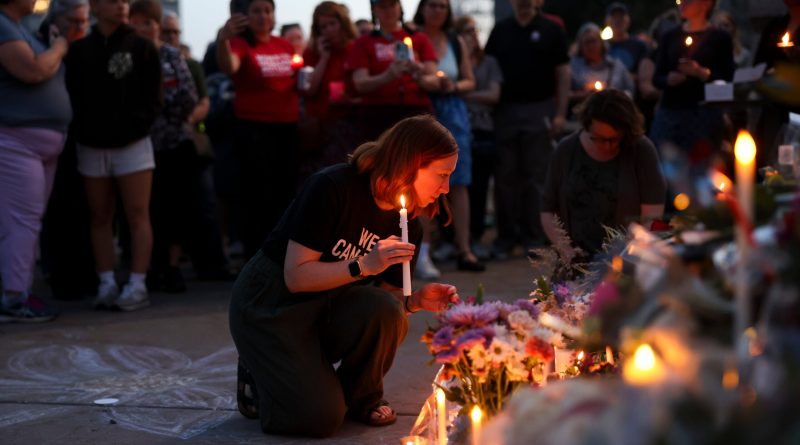
An example of this in recent memory is the assassination of Charlie Kirk. On September 10, 2025, at 12:23 pm, the right-wing activist and media figure was shot and killed at a public event at Utah Valley University. Charlie Kirk was a nationally recognized conservative activist, a key ally to President Donald Trump, and the founder of Turning Point USA, an organization focused on mobilizing young conservatives across college campuses. The organization invites conservative speakers to campuses and holds conferences that bring together thousands of young people to debate right-wing perspectives on political topics such as economics, race, and immigration: the reason why Kirk was there that day. Kirk’s assassination sparked an outcry about recent political violence spikes in the US. Many disagree on how this violence will impact American politics, but one thing can be known; it is not the first time we are seeing this type of violence.
Kirk’s assassination is not an isolated incident, but part of a broader pattern of rising political violence in the United States. The assassination occurred in the wake of several other acts of political violence that have been rising since 2011. In 2025 alone, we have seen multiple instances. In June, Minnesota Democratic state Rep. Melissa Hortman and her husband were fatally shot. On the same night, Minnesota state Sen. John Hoffman and his wife, Yvette Hoffman, were shot multiple times but survived. In April, the Pennsylvania governor’s residence was set on fire with Democratic Gov. Josh Shapiro and his family inside in an attempted murder.
These developments raise deeper concerns about the functioning of democracy itself, prompting questions about whether the United States is experiencing democratic decline, i.e., democratic backsliding. At its core, democracy is often understood as a system that reduces violence by channeling political conflict into elections rather than violent interactions. Scholar Adam Przeworski describes “democracy” as a method of processing conflicts: when actors agree to accept electoral outcomes, incumbents risk losing office by holding elections, but this is how the democratic system continues. In theory, this stabilizing effect should ensure less political violence. Yet, the United States today is experiencing the opposite. This should sound off alarms. Rather than working together to condemn it, people are just getting more used to violence and blaming opposite sides. This widening conflict and polarization feeds into other forms of violence, eroding the expectation that disputes can be managed peacefully within democratic norms.
When political violence becomes normalized in the public sphere, it produces widespread confusion and anger rather than collective condemnation. Many Americans are exposed to these horrific events but lack a clear understanding of their underlying causes or where responsibility should be placed. While 85 percent of Americans report that politically motivated violence is increasing, there is far less agreement about why it is occurring. In a recent Pew Research Center study, respondents were asked to explain, in their own words, the main causes of political violence in recent years; the most common explanations across partisan lines blamed the opposing political party. Unlike the 1960s, anger today is no longer directed primarily at the individual perpetrator, where accountability should rest, but instead is displaced onto entire political groups.
Elected officials and elites who have influence over parties in this critical moment should be acting fast to condemn this violent behavior as cowardly rather than heroic. Instead of condemning the violence and the individual, we have seen people, including President Trump, blame the opposing party.
After Kirk’s assasination, President Trump claimed that radical leftist groups foment political violence in the U.S., and on a later date said “[w]e have some pretty radical groups, and they got away with murder”. Steve Bannon, White House chief strategist during Trump’s first term, even said the right should “go to war” in the wake of Kirk’s assassination.
However, it’s important to put Trump’s framing in context. While his actions, including the September 2025 Antifa executive order, portrays left-wing groups as the main source of political violence, the broader data do not support that view. According to a 2025 Cato article on politically motivated violence, politically motivated murders in the U.S. are extremely rare, accounting for only 0.35% of all homicides since 1975. When they do occur, they come from multiple ideological directions. Overall, right-wing extremists account for about 63% of these murders compared to 10% committed by left-wing attackers. Since 2020, the pattern remains mixed, with right-wing, left-wing, and Islamist violence all present. However, we can see that political violence is concentrated on at least two foci: Islamic extremism and right-wing extremism.
This is the type of rhetoric that mobilizes a party against another. 73 percent of Democrats blame Republicans for political violence, and 50 percent of Republicans blame Democrats for political violence. Republicans feel threatened and feel like the opposing party is dangerous; Democrats feel targeted and helpless. Kirk’s case has only exacerbated this because it was so public. Millions watched the high profile leader executed in gory detail as they sat behind a screen because there was nothing they could do. It is something Americans have never seen before in such graphic detail. However, this horrifying event unfortunately has been a catalyst for the mass polarization of the general public, and the leaders who should be condemning it are only making it worse.
Democratic backsliding, as such a nuanced term, is hard to proclaim. Whether the U.S. is truly backsliding remains uncertain. What we are witnessing, though, are clear warning signs: weakened norms, leaders unwilling to condemn violence, and a public increasingly numb to it. These are all conditions that often precede backsliding. While it may be too soon to declare that democracy is unraveling, it’s undeniable that we are watching its foundations bend under pressure.
Perhaps the central issue isn’t that acts of political violence directly cause democracy to collapse, but that they fuel a growing polarization that corrodes democratic trust from the inside out. Each act of violence widens the gap between parties and makes peaceful power transitions feel less natural and more like battles. Democracy depends on losers accepting outcomes; when violence replaces dialogue and distrust replaces compromise, that peaceful cycle begins to erode.
If there’s a way forward, it begins with refusing to villainize the other side. Americans must relearn how to see political opponents as legitimate, not as enemies. That respect is the first step toward rebuilding a political culture that condemns violence no matter where it comes from. Healing won’t come from blame, but from accountability and compromise; only then can we begin to break the cycle of political violence.
Author’s Bio
Charlotte Cardel graduated from the University of Michigan in December 2025 with a dual degree in International Studies and Spanish, concentrating in comparative culture and identity. She spent a significant portion of her undergraduate career studying in Spain, while working at a non-profit, where she developed a strong interest in cross-cultural understanding and international perspectives. At Michigan, Charlotte contributed multiple undergraduate articles to the Michigan Journal of International Affairs and was involved in Sigma Iota Rho, the International Studies Honor Society, as well as the Empowering Women in Law Association. Her academic work reflects a sustained interest in contemporary political issues in the United States and abroad. Charlotte plans to pursue a career in law and will begin working as a litigation paralegal at Paul, Weiss in New York City in July 2026.
Edited by: Leslie Rios, MPP/MA ’26, Gary Alvarez, MPP/PhD